Friday, November 13, 2009

The Great "Czech" Pretender


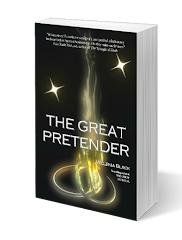
Reginald Brooks and family continue to demonstrate the universal nature of their story with their arrival in the Czech Republic! My first novel, THE GREAT PRETENDER, is "Zůstaň se mnou" in the Czech Republic. "Rolkesen" in Turkey. "Wielki Klamca" in Poland. Citizens of the world, right?

And in other news, check out this great post from author Bernice McFadden. She asks a great question! How are we going to get that very important memo to the publishing industry?


Share/Bookmark Subscribe

Monday, October 05, 2009

The Advantages of Being a White Writer by Justine Larbalestier

I'm extremely encouraged to see this recent post by author Justine Larbalestier. In my last post on character treatments, I asked who is decent enough to get honest about the literary climate and its effects. Justine Larbalestier certainly is. And we need more writers willing to step up to the plate like her and be honest about the climate and what it means for authors who aren't white...until the climate improves and provides equal opportunity for all.

This writer has a very clear understanding of the problem, as you can glean from the way in which she introduced the discussion:

I know that the title of this post is going to lead to some comments insisting that it’s not true that white writers have any advantages and that many white people are just as oppressed as people of colour. I don’t want to have that conversation. So I’m going to oppress the white people who make those comments by deleting them. I don’t do it with any malice. I do it because I want to have a conversation about white privilege in publishing. We can have the discussion about class privilege and regional privilege and other kinds of privilege some other time. Those other privileges are very real. But I don’t want this discussion to turn into some kind of oppression Olympics.

Can you even imagine the verbal lynching a non-white author would receive saying something like this?

Justine goes on to say:

I want to make it clear that I’m not saying that we white writers should feel guilty about any of this. Guilt is a pointless emotion. White writers who’ve written about people of colour and won acclaim and awards don’t have to hand their prizes back. That would change nothing.

What I am saying is that we need to be aware of our privilege and listen to criticism and act upon it. We need to do what we can to change things. The more novels with a diversity of characters that are published and succeed in the marketplace the more space there will be. The more people who can find themselves in books, the more readers we’ll all have, and the more opportunities there’ll be for writers from every background. Of course, it’s not just the writers who need to be more diverse, but everyone in publishing, from the interns to agents to the folks in sales, marketing, publicity, and editorial, to the distributors and booksellers.

There are many wonderful books by writers of colour. Read them, talk about them, buy them for your friends. Point them out to your editors and agents. Be part of changing the culture and making space for lots of different voices. The problem is not so much what white people write; it’s that so few other voices are heard. If the publishing industry were representative of the population at large we wouldn’t need to have this conversation.

Thank you, Justine. Where have you been all my life? :-) You've actually lifted my spirits and renewed my hope.

Share/Bookmark Subscribe

Tuesday, September 01, 2009

Character Treatments: Do They Tell a Story?

Here's commenter Rowan Michaels' enlightening view on my previous post:

Millenia - it is so true what you say about white writers. If they can't even see their characters equally, what does that say for how they see real people? White characters get described to the reader: face features, hair color, eye color, etc. but when the character is not white, they get treated differently. They can't just be described to the reader like the white characters are, the reader is told first off that this is not "one of us". It's really sad. I always noticed it, but never thought of it in terms of how it exposes the way most whites (even when they don't consider themselves racist) view non-whites and how that results in subtle (and sometimes not so subtle) acts of discrimination.

Can Oprah do anything about this? Hell yes! Oprah is one of the most influential people in the world. She commands attention and respect. Nobody preaches finding your "authentic self" and living your "best life" like Oprah. Is it just a sham brand, or does she really mean it? She could make a huge difference by talking consistently about these types of ways that racial division rears its head and hurts people, cripples many lives and family potential.

It is not so hidden after all, is it? Walk into any bookstore and crack open a bestseller--race division screaming at you. So true. This is no doubt a hard post to read for white authors and white persons in general, but it is still the truth, and somebody needs to have the courage to say it.

What is the key to solving a persistent problem? When symptoms of an imbalance keep cropping up, doesn't that mean the cause of the imbalance isn't being addressed? Complaints abound, but for those of us seeking a solution, isn't something missing?

Who is decent enough to get honest about the literary climate...and its effects?

Share/Save/Bookmark Subscribe

Wednesday, August 26, 2009

Book Industry Racism...Where is Oprah?

With the news that Oprah’s latest book club selection will be announced on September 18th, the question of where she stands on the indisputable practice of racism in the publishing industry remains outstanding. Her announcements are major events, and play a significant role in the landscape of the book industry and marketplace.

In December of 2006, The Wall Street Journal published an article entitled, “Why book industry sees the world split still by race.” Considering the fact that Oprah Winfrey is the publishing industry’s greatest marketing tool, it isn’t unreasonable, in my view, to wonder why she hasn't addressed the sustained system of racial marginalizing in which, even as I type this, most publishing houses are engaged. Oprah's selections help to line the pockets of these corporations, while they consistently - and unapologetically - treat acquisitions according to the author's race vs. the manuscript's content. And in many cases, expect and force non-white authors to write their manuscripts according to their race so the publisher can limit the author's marketability to his/her own race of readers, and not to the much larger, universal marketplace.

Why haven’t we heard from Oprah on this issue?

Here's my view. She’s likely not really aware of it. Unless an issue reaches her directly, it must go through the Oprah Show’s “producer mill.” If they decide an issue isn’t important or have reasons for not wanting certain things made public, it never gets through to Oprah herself. On the issue of racism in an industry Oprah has such a powerful influence on, many of her producers work and have formed relationships with the major publishing houses – they are not interested in disrupting their cushy acquaintances, and the advantages they may provide. So they turn a blind eye to the blatant racism their “buddies” are engaged in, even tipping them off about efforts to call Oprah's attention to the matter. Like most of white America, the producers are invested in ignoring it. It’s not their problem, and most of them cringe when Oprah does shows about racism, anyway.

I submit that due to her attained significance in the industry, Oprah, herself, is the only one who can have a significant impact on this issue, and put it to bed once and for all. If she speaks out against some of the proven, racially discriminatory practices, the publishing houses will listen. They will have to stop seeing the world split still by race, hence stopping the perpetuating of the split itself. They will have to stop justifying racially-based marketing and internal business practices. They will have to think twice about angering the biggest marketing tool they have ever had, and maybe ever will have.

How can she not talk about this?

The recent issue with author Justine Larbalestier’s book, Liar, shows that such incidents aren’t going anywhere, as the real dirt has yet to be cleaned up. Publishers continue to maintain (despite their vehement denials) a very racist mindset, culture, and business model, and it’s reflected in their most consistent practices. The fact that this white author sees a need for greater inclusion and commercializing of non-white characters/story/plot, etc., into the “mainstream” shows that clearly non-white authors are marginalized, even to the disturbance of fellow white authors, who are feeling urged to do something about it.

Who has noticed this about most books by white authors? That the use of racial identifiers is reserved for the non-white characters in the stories. I have noticed this for years. It’s an easy place to see the deeply ingrained racist conditioning that still plagues this entire society, and will continue to do so until it is acknowledged by those who perpetuate and sustain it, and is finally honestly addressed. Most white authors don’t even realize they are subconsciously marginalizing “others” who are not of their own race. Think about it. What is a non-white reader to think as they read these books? Books that are clearly being written with a white audience in the subconscious mind. Why doesn't the author have to tell the reader that all the white characters are white? But they feel compelled to tell the reader when a character(s) is Black, Hispanic, Asian, Native American, etc. Why is that? What does this reflect?

So why wouldn’t Oprah – the most prominent figure in publishing – want to talk about this?

Share/Save/Bookmark Subscribe

Thursday, November 06, 2008

One Small Step For Man...


Yes We Did

By Marianne Williamson

America has had a non-violent revolution.

As long as there are historians writing about the United States, this moment of fundamental re-alignment of our national purpose will be remembered, pored over and analyzed. It will be seen as one of the shining points along the evolutionary arc of the American story. Yet it will never submit itself to being summed up in a nice little package that reason alone can understand.

It's been noted before that Americans get excited about politics every forty years. Then, in the words of comedian Will Rogers, "We have to go sleep it off."

We were certainly excited in the l960's. And this is 2008; exactly forty years since the most dramatic and violent year of the Sixties decade: the year when both Bobby Kennedy and Martin Luther King Jr. were literally killed before our eyes.

At that point, a generation of young people -- looking much like the youthful army so out in full force today, only grungier -- marched in the streets to repudiate an oppressive system and to try to stop an unjust war. And then bullets stopped us. The shots that killed the Kennedy's and King carried a loud, unspoken message for all of us: that we were to go home now, that we were to do whatever we wanted within the private sector, yet leave the public sector to whomever wanted it so much that they were willing to kill for it. And for all intents and purposes, we did as we were told.


According to ancient Asian philosophers, history moves not in a circle but in a spiral. Whether as an individual or as a nation, whatever lessons we were presented once and failed to learn will come back again but in a different form. For the generation of the Sixties and for our children, the lessons of that time -- as well as its hopes and dreams and idealism -- came back in 2008.


During our forty years in the desert, we learned many things. Then, we marched in the streets; this time, we marched to the polls. Then, we shouted, "Hell no, we won't go!" This time, we shouted, "Yes, we can." Then, we were so angry that our anger consumed us. This time, we made a more compassionate humanity the means by which we sought our goal as well as the goal itself.


In the words of Gloria Steinem, "I feel like our future has come back." And indeed it has. For in the words of Martin Luther King, Jr., "No lie can last forever." What Bobby Kennedy tried to do, and was killed for trying; what Martin Luther King tried to do, and was killed for trying; what the students at Kent state were trying to protest, and were killed for daring to; Barack Obama and his army of millions of idealists with the audacity to hope have now succeeded at doing.


Praise God. Praise God.


And that praise to God didn't just go out last night, when Obama's election to the Presidency was finally achieved. That praise was part of what allowed the waters to part here in the first place. Millions of Americans have been deeply aware that this kind of historic and fundamentally positive effort has not gone well in the recent past, and the spiritual understanding of this generation of Americans -- an understanding not yet fully formed forty years ago -- created an invisible light around the Obama campaign. How many people over the last twenty-one months have posted, in their own way, angels to Obama's left and angels to his right, angels in front of him and angels behind him, angels above him and angels below him? I know I have, and so has everyone I know. Hopefully we will continue to do so.


The Obama phenomenon did not come out of nowhere. It emerged as much from our story as from his -- as much from our yearning for meaning as from his ambition to be President; as much from our determination to achieve collective redemption as from his determination to achieve an individual accomplishment. And those who fail to recognize the invisible powers at work here -- who see the external drama of politics yet fail to discern the profound forces that moved mountains by moving the American heart -- well, they're just like Bob Dylan's Thin Man to whom he sang, "You don't know what's going on here, do you, Mr. Jones?"


Back then, Mr. Jones didn't know what was going on, but many of us did. We knew what was going on then and we knew what needed to happen; we simply weren't mature enough and we were too wounded then, as people and as a culture, to pull it off.


This time, we both knew and we did. We knew who we had to become and we knew what we had to do. The violent American revolution of 1776 entailed separating from another country. The non-violent revolution of 2008 -- a non-violent revolution that did not quite fail, yet also did not quite succeed in the l960's -- has entailed separating from who we used to be.


In the l960's, we wanted peace but we ourselves were angry. This time, after hearing Gandhi's call that we must be the change we want to see happen in the world, we came to our political efforts with an understanding that we must cast violence from our hearts and minds if we are to cast it from our world; that we must try to love our enemies as well as our friends; and that when a genius of world-historic proportions emerges among us, we cannot and we must not fail to do everything humanly and spiritually possible to support him. For his sake…and for ours.


Having gone to a higher place within ourselves, a higher level of leadership began to emerge among us. A higher level of leader now having emerged among us, he calls us to an even higher place within ourselves. And from this spiraling dance, these two forces together can and will, as Obama has told us, truly change the world. Having moved one mountain, we will now go about the work of removing the ones that remain.


With God's help, yes we can. Yes we did. And yes we will.


--- by Marianne Williamson,

author of Healing the Soul of America Visit www.marianne.com

Thursday, September 11, 2008

Change a (Your) Life.


Kiva - loans that change lives

Wednesday, May 14, 2008

Yes We Can.

Zoe Kravitz, et al. - "We Are the Ones"

I love this.

Tuesday, May 13, 2008

A Horse of a Different Color

So I always dreamed of being like Jackie Collins or Danielle Steel. Of having a career that had nothing to do with my color, everything to do with my stories.

I dreamed of reaching an audience so large that I, too, would one day sell over 400-500 million novels. Or over 300 million, like Sidney Sheldon. Or over 200 million, like Nora Roberts. Or (even) over 70 million, like Sandra Brown. My dream was sooo bright; as bright as the sun itself. I always believed it was attainable. Sink or swim...

I thought there was an equal opportunity.

But despite the current atmosphere, I still have a great deal of faith in the American publishing industry. I am an American. And I believe we can repair the hurtful, Jim Crowesque climate that plagues American publishing. We must. For as Eckhart Tolle carefully explains in A NEW EARTH: What we do to others, we do to ourselves.

I maintain confidence that my stories will find their way into the American mainstream, where they belong. Like any other, they deserve to have a fair chance in the marketplace, don't they? Unfettered by any "color-of-the-author" impositions?

If Reginald Brooks and family can be Polish, and Turkish...surely they can be American. Very few self-published novels prove themselves to be captivating stories with tremendous universal appeal. So that proven appeal validates the dream I've always had for my stories, and keeps it alive. Who knows? I may even be inclined to launch my own (equal opportunity) publishing empire to help foster fair chance in the industry; set an example for what it means to provide equal opportunity...

The last three years of my life have been dreadful...but now, thank God, healing begins; because what I know for sure is this: I am, as they say, a flame keeper. And the flame glows brightly. I can see it going before me now, leading the way to a much better experience.

On Writing.
The seeds of a third book (THE GREAT MASTERMIND) have been patiently awaiting my return to the keyboard. Those seeds deserve life and nourishment; it's high time I saw to them. And ditto for my blog! There's so much going on these days, and I've not had an ounce of energy to participate. But I'm getting back to creating now. After being down in the dumps, unable to write for such a long, long time - I pledge to start living again. That means birthing my next page-turner! I know my fans have been patiently waiting...and I love them for it.

The Discrimination Lawsuit.
I've received several inquiries about the status. I'm very pleased to share that the matter has now been resolved to my satisfaction through an agreement, the terms of which can never be discussed.

In the interest of my blog's archival integrity, I fully disclose that all previous discussions about the case have been removed. There will be no further information about the lawsuit on my blog. I'm extremely happy to have this heartbreak behind me - I give beaucoup thanks to my wonderful attorney. And I likewise send a deep, heartfelt THANK YOU to everyone who offered their unwavering support. I'll remember it always.

Census: Bestsellerdom.
Beyond all of that, here's a very important question:

Was having such a dream foolhardy?

Would Jackie Collins, or Danielle Steel, or Nora Roberts all have been foolish to dream of achieving what they have, in fact, achieved?

Should the horse have known not to enter the race? Is having a white body a prerequisite for access to the stratosphere of the commercial fiction business? Access to the upper crust, where Jackie, Danielle, Nora (et al.) reside?

"The Negro was to accept the biracial system and his subordinate status. He was to seek advancement within the confines of his segregated black world. He was to develop the friendship of influential whites and use their assistance.

By cultivating habits of hard work, thrift, and honesty, he was to demonstrate his claim to wider acceptance and better treatment. Above all, he was never to present any organized challenge to the existing order of things or engage in movements which might be regarded by whites as detrimental to their economic and political interest." - Booker T. Washington

Boy. Why can't we simply stop making color distinctions and just allow love to unite all Americans?

Is Booker T's observation of 100 years ago -still- true for commercial fiction publishing in the United States? If so, who bears the responsibility?

At this time in our history -2008- does our publishing establishment have any non-white, commercial fiction authors with sales/audience comparable to Danielle Steel's? Jackie Collins'? Or (even) Sandra Brown's? If so, who?

(Well, I guess there are a few very important questions.)


Share/Save/Bookmark Subscribe

Wednesday, August 22, 2007

The Great "Turkish" Pretender


As most of you can imagine, I've been experiencing some very trying times, and just haven't had the energy to blog in the last few months. But I had to make a special effort to share the cover of the Turkish edition of THE GREAT PRETENDER (ROLKESEN) with my readers; as I've previously shared the Polish cover (WIELKI KLAMCA).

And it's worthwhile to note (though I'm pretty sure I've mentioned it before) that these foreign versions were garnered by the 2002 self-published, general fiction edition of TGP......

How often do self-published books sell foreign translation rights?

It's interesting how these covers reflect and illustrate the universal substance of the very same book.

Share/Save/Bookmark Subscribe

Saturday, April 07, 2007

Clandestine Trap Contest - Congratulations!

Of course, the deadline has passed. Thanks to all the participants, you were great sports!! I received over 40 entries, but only 4 had the correct answer. Here are the winners:

Gladys Howard, WA
Shelia Goss, LA
Faith Covington, UK
Christy Hawkes, UT

Congratulations! Hope you enjoy THE GREAT BETRAYAL - all copies have been mailed!

Now, what was the narrator's secret? The narrator is an unsolved murder victim.